→
Back to home
Orion
GenAI Research Assistant for Drug Development
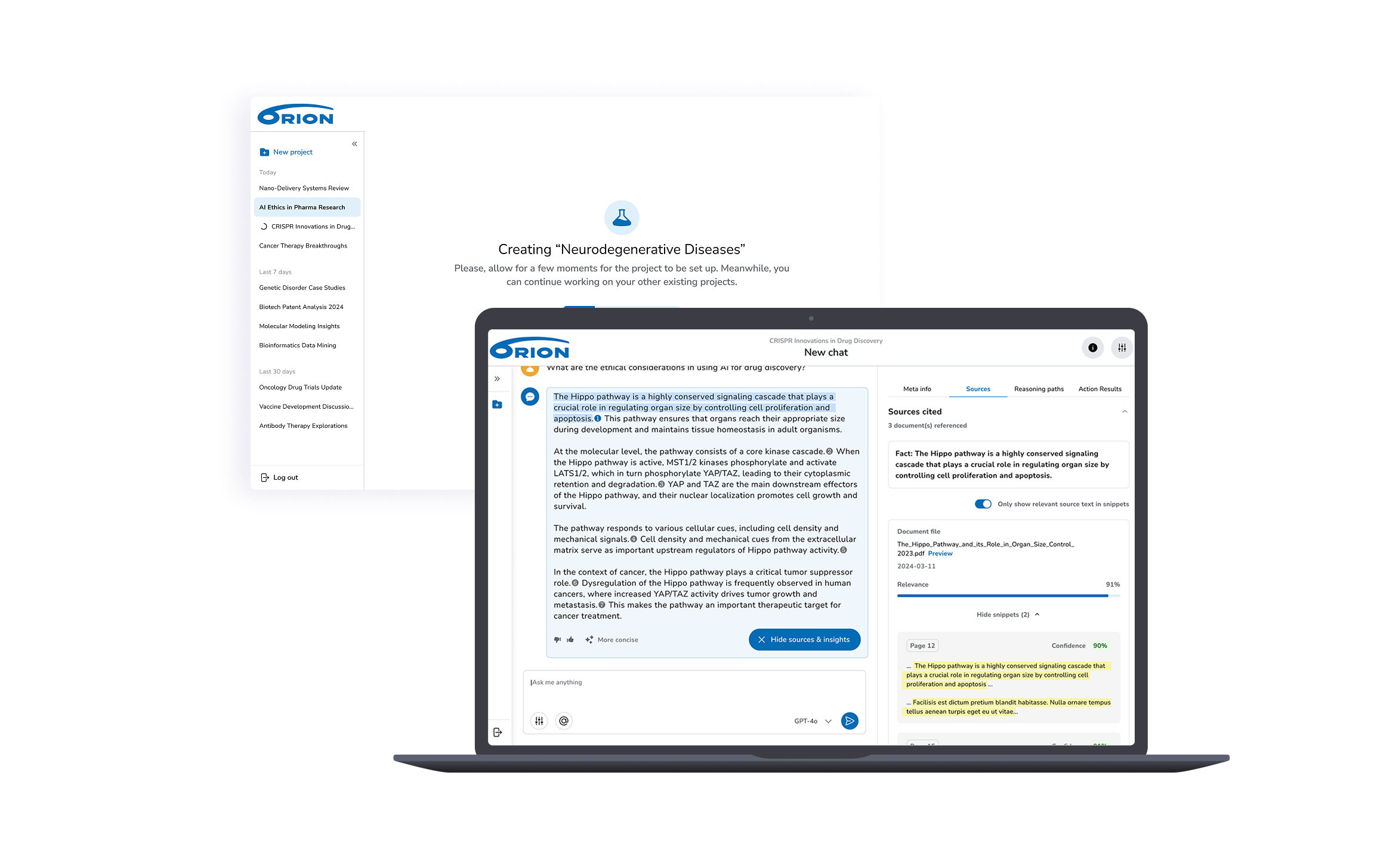
Orion is a global pharmaceutical company exploring how GenAI can speed up research and medical affairs work. The team built a tool that lets users upload scientific documents, ask questions in natural language, extract insights, and verify facts through citations. I joined during the later stages to refine the UX/UI and design features that made the tool clearer, more trustworthy, and easier to use in a research-heavy environment.
The problem
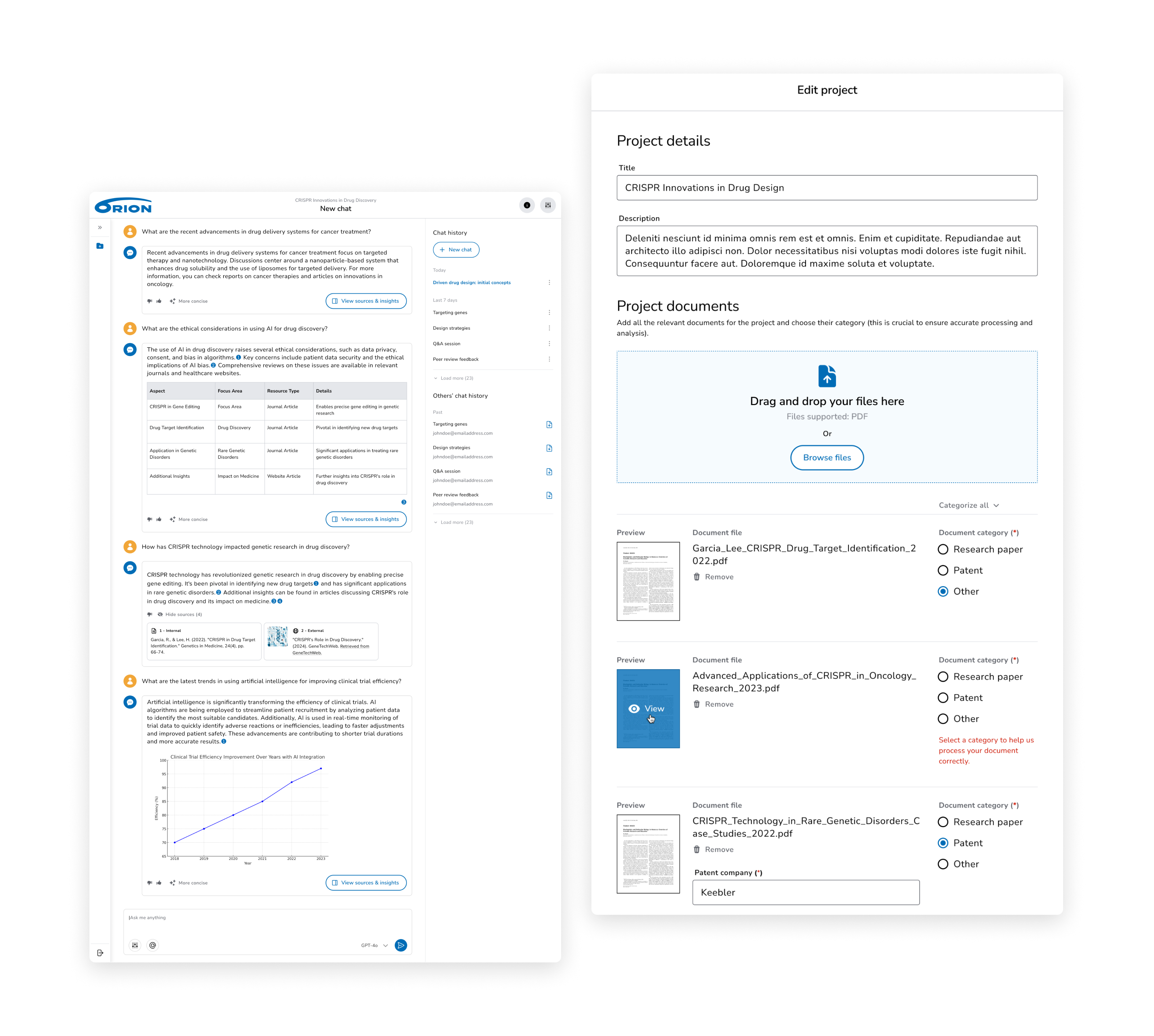
Orion’s researchers navigate thousands of pages of scientific content spread across studies, presentations, patents, and internal documents. Finding specific information is slow, and traditional search tools struggle with scientific language, cross-document context, and reliable sourcing. Orion needed a way to surface accurate insights quickly, with transparent links back to original material.
My role
I focused on improving usability, clarity, and trust within the interface:
- Refined the structure and readability of the chat and result views
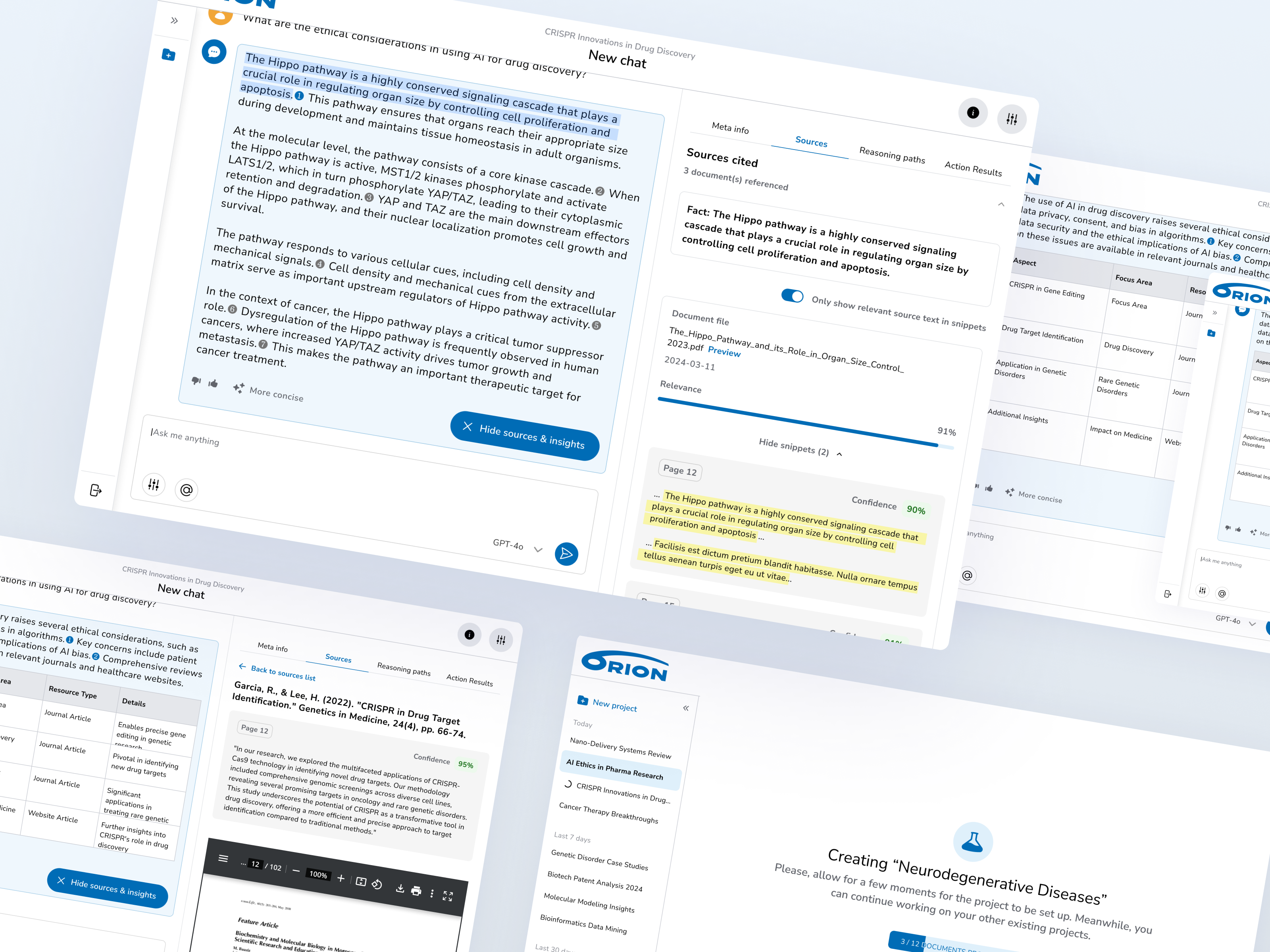
- Designed ways to explore LLM responses through expandable evidence and citations
- Improved workflows for switching between chat, document context, and research tasks
- Created interaction patterns for uncertainty, ambiguity, and low-confidence answers
- Helped transform early prototypes into a more polished, research-ready product
My work centered on making the tool easier to understand and more dependable for scientific use.
Key contributions
Designing insight-expansion patterns
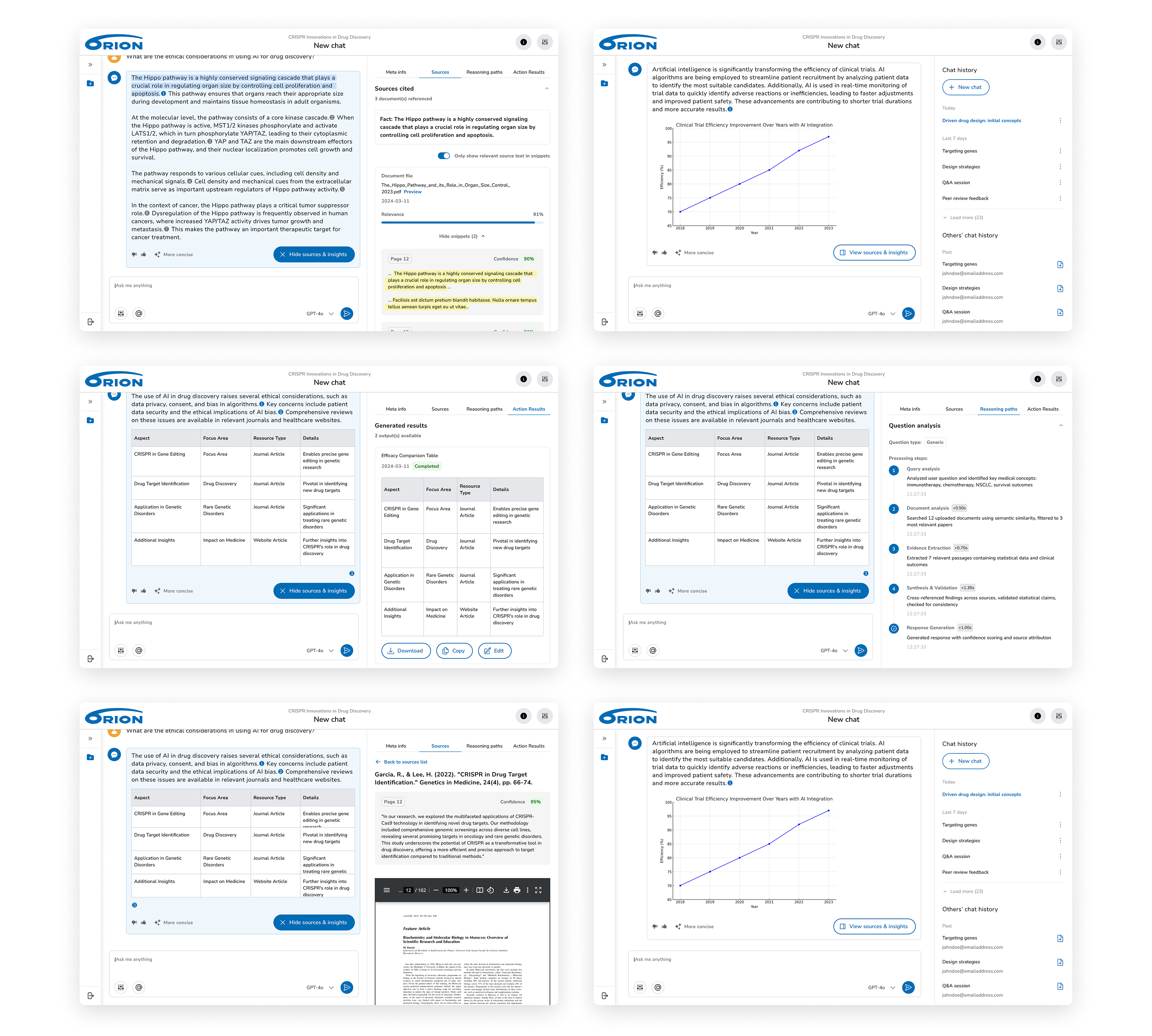
I designed a clearer way to inspect LLM answers, including:
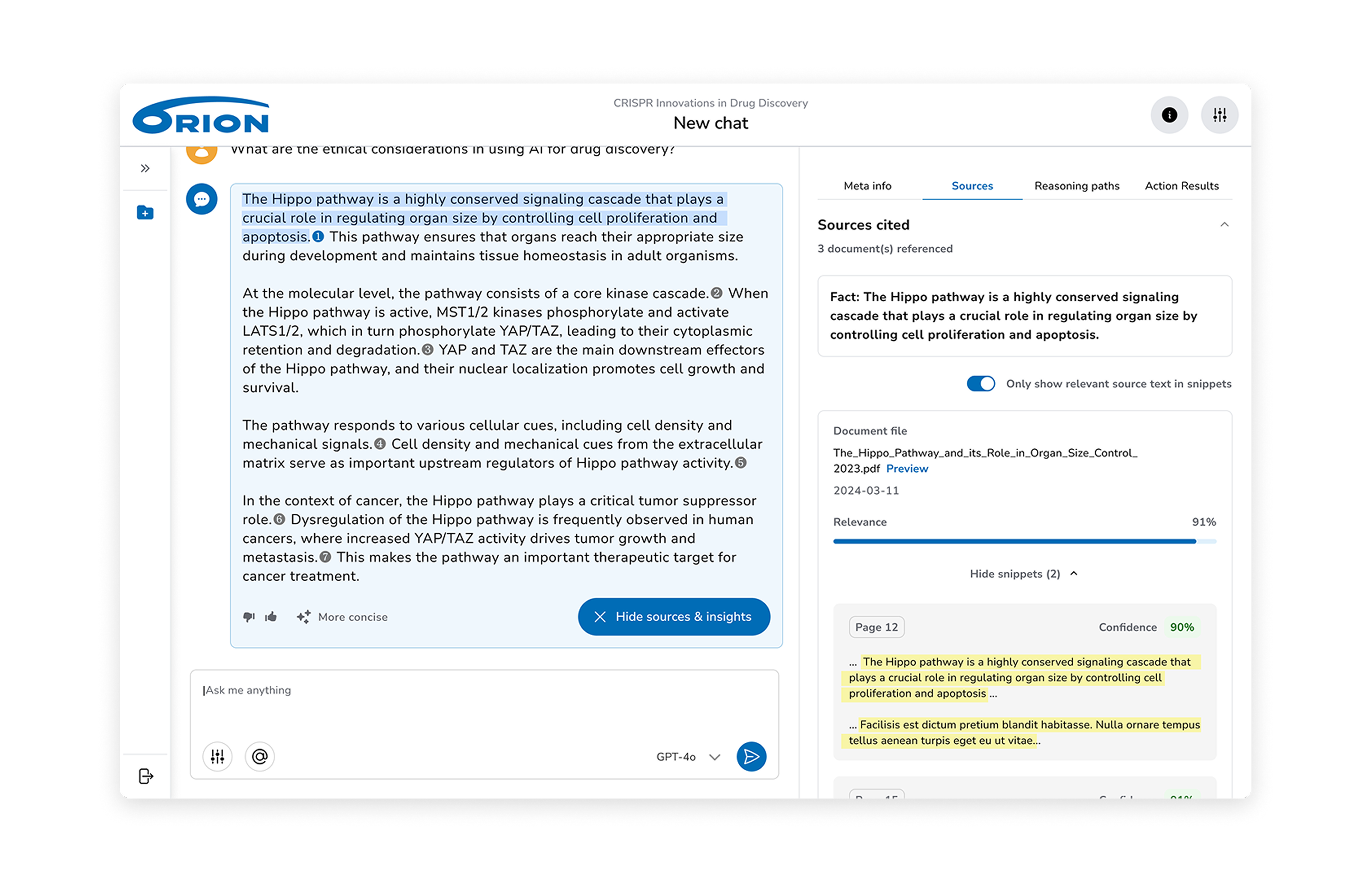
- Evidence previews
- Linked citations
- Confidence indicators
- Clear separation of key points and supporting details
This improved transparency and helped researchers verify information at a glance.
Readable structure for long outputs
Scientific responses can be dense. I redesigned the output layout into:
- Key points
- Details
- Sources
- Suggested follow-ups
This reduced cognitive load and made long answers easier to scan.
UI refinements for research workflows
I refined spacing, typography, hierarchy, and layout across the interface to support:
- Long-form reading
- Document-based exploration
- Switching between files and chat
- Multi-document query contexts
This made the tool feel more stable, more trustworthy, and more oriented toward real-life pharmaceutical workloads.
How I worked
- Collaborated daily with engineers, the LLM lead, and product
- Reviewed early chat patterns and improved them with clearer structure and affordances
- Designed modular UI patterns for future expansion (new data sources, new analysis types)
- Helped define edge-case behaviours, especially around uncertainty and low-confidence answers
Impact
- More trustworthy LLM responses through clearer sourcing
- Faster insight extraction thanks to improved structure and readability
- A more coherent interface aligned with how researchers actually work
- Design patterns adopted as the foundation for continued expansion
What I learned
- Designing for factuality and clarity in scientific and regulated environments
- Structuring AI-generated output for quick scanning
- Balancing AI assistance with scientific rigor
- Communicating uncertainty in a way researchers can trust
→
Back to home
Orion
GenAI Research Assistant for Drug Development
Orion is a global pharmaceutical company exploring how GenAI can speed up research and medical affairs work. The team built a tool that lets users upload scientific documents, ask questions in natural language, extract insights, and verify facts through citations. I joined during the later stages to refine the UX/UI and design features that made the tool clearer, more trustworthy, and easier to use in a research-heavy environment.
The problem
Orion’s researchers navigate thousands of pages of scientific content spread across studies, presentations, patents, and internal documents. Finding specific information is slow, and traditional search tools struggle with scientific language, cross-document context, and reliable sourcing. Orion needed a way to surface accurate insights quickly, with transparent links back to original material.
My role
I focused on improving usability, clarity, and trust within the interface:
- Refined the structure and readability of the chat and result views
- Designed ways to explore LLM responses through expandable evidence and citations
- Improved workflows for switching between chat, document context, and research tasks
- Created interaction patterns for uncertainty, ambiguity, and low-confidence answers
- Helped transform early prototypes into a more polished, research-ready product
My work centered on making the tool easier to understand and more dependable for scientific use.
Key contributions
Designing insight-expansion patterns
I designed a clearer way to inspect LLM answers, including:
- Evidence previews
- Linked citations
- Confidence indicators
- Clear separation of key points and supporting details
This improved transparency and helped researchers verify information at a glance.
Readable structure for long outputs
Scientific responses can be dense. I redesigned the output layout into:
- Key points
- Details
- Sources
- Suggested follow-ups
This reduced cognitive load and made long answers easier to scan.
UI refinements for research workflows
I refined spacing, typography, hierarchy, and layout across the interface to support:
- Long-form reading
- Document-based exploration
- Switching between files and chat
- Multi-document query contexts
This made the tool feel more stable, more trustworthy, and more oriented toward real-life pharmaceutical workloads.
How I worked
- Collaborated daily with engineers, the LLM lead, and product
- Reviewed early chat patterns and improved them with clearer structure and affordances
- Designed modular UI patterns for future expansion (new data sources, new analysis types)
- Helped define edge-case behaviours, especially around uncertainty and low-confidence answers
Impact
- More trustworthy LLM responses through clearer sourcing
- Faster insight extraction thanks to improved structure and readability
- A more coherent interface aligned with how researchers actually work
- Design patterns adopted as the foundation for continued expansion
What I learned
- Designing for factuality and clarity in scientific and regulated environments
- Structuring AI-generated output for quick scanning
- Balancing AI assistance with scientific rigor
- Communicating uncertainty in a way researchers can trust
→
Back to home
Orion
GenAI Research Assistant for Drug Development
Orion is a global pharmaceutical company exploring how GenAI can speed up research and medical affairs work. The team built a tool that lets users upload scientific documents, ask questions in natural language, extract insights, and verify facts through citations. I joined during the later stages to refine the UX/UI and design features that made the tool clearer, more trustworthy, and easier to use in a research-heavy environment.
The problem
Orion’s researchers navigate thousands of pages of scientific content spread across studies, presentations, patents, and internal documents. Finding specific information is slow, and traditional search tools struggle with scientific language, cross-document context, and reliable sourcing. Orion needed a way to surface accurate insights quickly, with transparent links back to original material.
My role
I focused on improving usability, clarity, and trust within the interface:
- Refined the structure and readability of the chat and result views
- Designed ways to explore LLM responses through expandable evidence and citations
- Improved workflows for switching between chat, document context, and research tasks
- Created interaction patterns for uncertainty, ambiguity, and low-confidence answers
- Helped transform early prototypes into a more polished, research-ready product
My work centered on making the tool easier to understand and more dependable for scientific use.
Key contributions
Designing insight-expansion patterns
I designed a clearer way to inspect LLM answers, including:
- Evidence previews
- Linked citations
- Confidence indicators
- Clear separation of key points and supporting details
This improved transparency and helped researchers verify information at a glance.
Readable structure for long outputs
Scientific responses can be dense. I redesigned the output layout into:
- Key points
- Details
- Sources
- Suggested follow-ups
This reduced cognitive load and made long answers easier to scan.
UI refinements for research workflows
I refined spacing, typography, hierarchy, and layout across the interface to support:
- Long-form reading
- Document-based exploration
- Switching between files and chat
- Multi-document query contexts
This made the tool feel more stable, more trustworthy, and more oriented toward real-life pharmaceutical workloads.
How I worked
- Collaborated daily with engineers, the LLM lead, and product
- Reviewed early chat patterns and improved them with clearer structure and affordances
- Designed modular UI patterns for future expansion (new data sources, new analysis types)
- Helped define edge-case behaviours, especially around uncertainty and low-confidence answers
Impact
- More trustworthy LLM responses through clearer sourcing
- Faster insight extraction thanks to improved structure and readability
- A more coherent interface aligned with how researchers actually work
- Design patterns adopted as the foundation for continued expansion
What I learned
- Designing for factuality and clarity in scientific and regulated environments
- Structuring AI-generated output for quick scanning
- Balancing AI assistance with scientific rigor
- Communicating uncertainty in a way researchers can trust